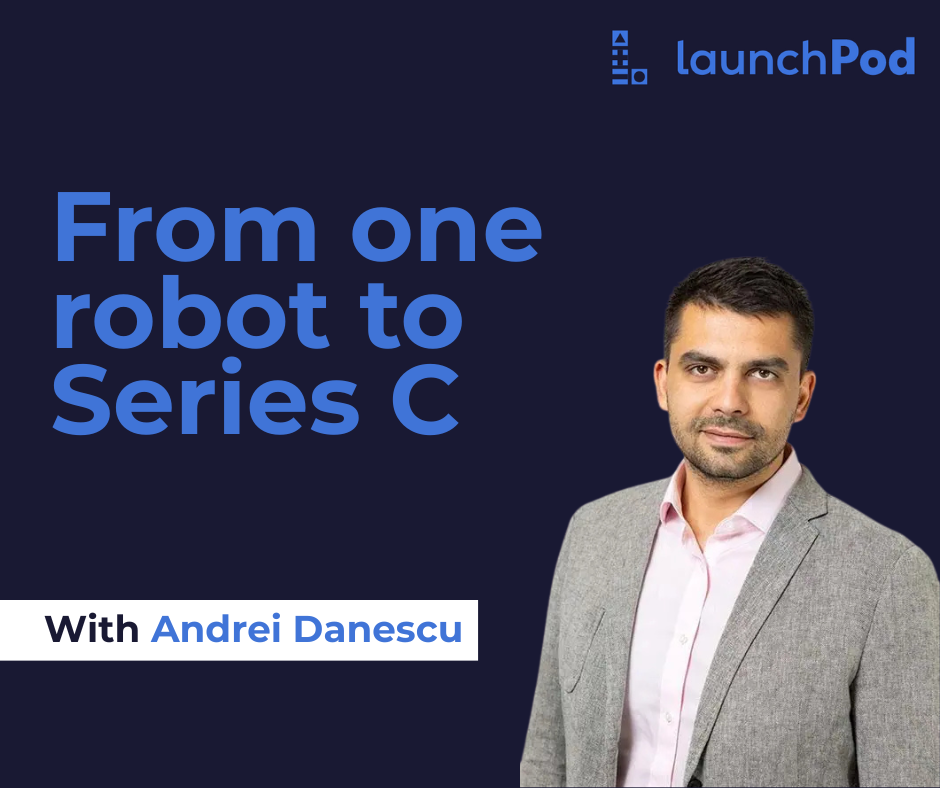
“We built the world’s tallest robot. And it broke in 5 minutes.
And you know what? That was OK.”
That’s how Andrei Danescu, founder and CEO of Dexory, summed up years of building, failing, and rebuilding in one sentence during our latest LaunchPod episode.
Before the Series C headlines and the global fleet of autonomous robots transforming warehouse operations, there were long nights, rejections, and a relentless belief that this would work.
Before raising their first investment, Dexory bootstrapped for over five years.
Andrei worked two jobs to fund early prototypes, pitched dozens of investors, and got rejected 127 times.
“When something truly matters, you find a way,” he says.
Those years forced the team to make smarter decisions, move fast, and stretch every resource — habits that later made them investable. Bootstrapping isn’t just survival; it’s training for resilience.
Instead of giving up after failed fundraising attempts, the Dexory team went after public funding and EU grants, eventually securing €5.5M.
They treated grants like venture capital: milestones, deliverables, accountability — and used that support to fund R&D and refine the tech before scaling.
👉 Lesson: Grants can buy time, validation, and technical maturity. If you treat them strategically, not as charity.
Originally focused on retail robotics, Dexory faced a dead end when the pandemic hit.
Instead of waiting it out, they pivoted fast to logistics, where warehouses were desperate for automation.
It meant rebuilding their stack, rebranding, and repositioning the company.
That bold move became their breakthrough.
👉 Lesson: A pivot isn’t failure, it’s alignment. The faster you face reality, the quicker you’ll find traction.
Like most hard-tech founders, Andrei had to sell before everything worked perfectly.
He learned to pitch the impact, not just the specs.
“You don’t sell features,” he says. “You sell the world that exists once your product works.”
👉 Lesson: Vision-first founders win the early believers who help you survive the imperfect stage.
Fast forward to today — Dexory has closed its Series C, backed by top European investors.
Their fleet of autonomous robots now powers global warehouses, turning physical spaces into digital, data-driven systems.
And it all started with one broken robot.
👉 Lesson: Every “failure” is a prototype. If you’re building something hard, let it break — then rebuild smarter.
At the end of our chat, Andrei shared three books that shaped his mindset as a founder:
📘 Winning – Jack Welch
📘 The Art of the Start 2.0 – Guy Kawasaki
📘 Extreme Ownership – Jocko Willink
🎧 Listen to the full podcast episode here:
An initiative of Launch Romania powered by BCR with the support of Google and its founding partner How to Web and media partners start-up.ro.

Press Release, September 13, 2023 After a successful first edition organised in May 2023, Launch […]
Citeste mai mult
Ai o idee de business. Una în care crezi mult. Bun, bun, dar întrebarea e […]
Citeste mai mult
Comunicat de presă, 19 mai 2023 Două noi proiecte românești în industria de tehnologie pentru […]
Citeste mai mult
Comunicat de presă, 3 mai 2023 Launch Health Tech, primul eveniment dintr-o serie dedicată ecosistemului […]
Citeste mai mult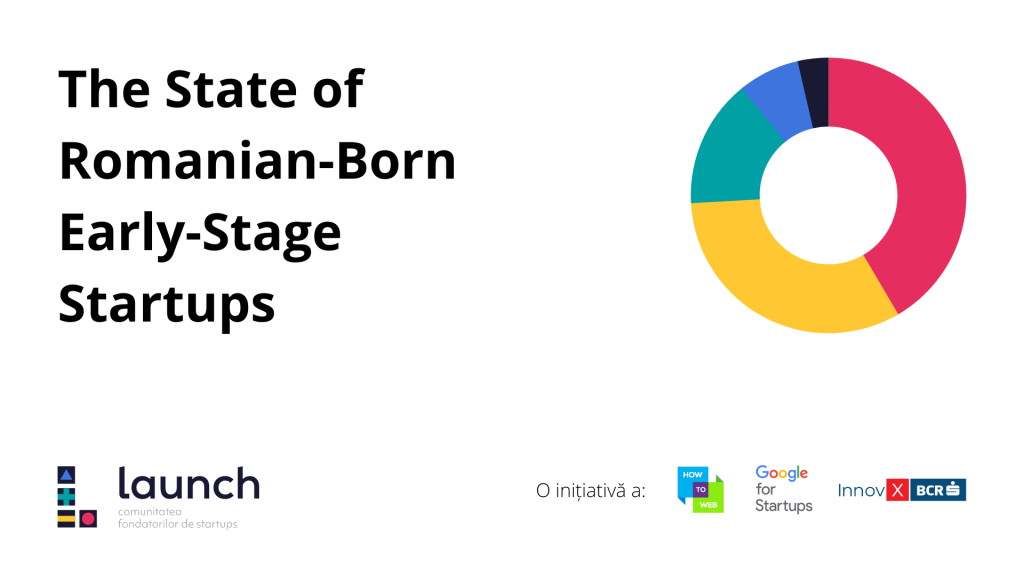
issued by Launch Community, an initiative of How to Web | Google for Startups | […]
Citeste mai mult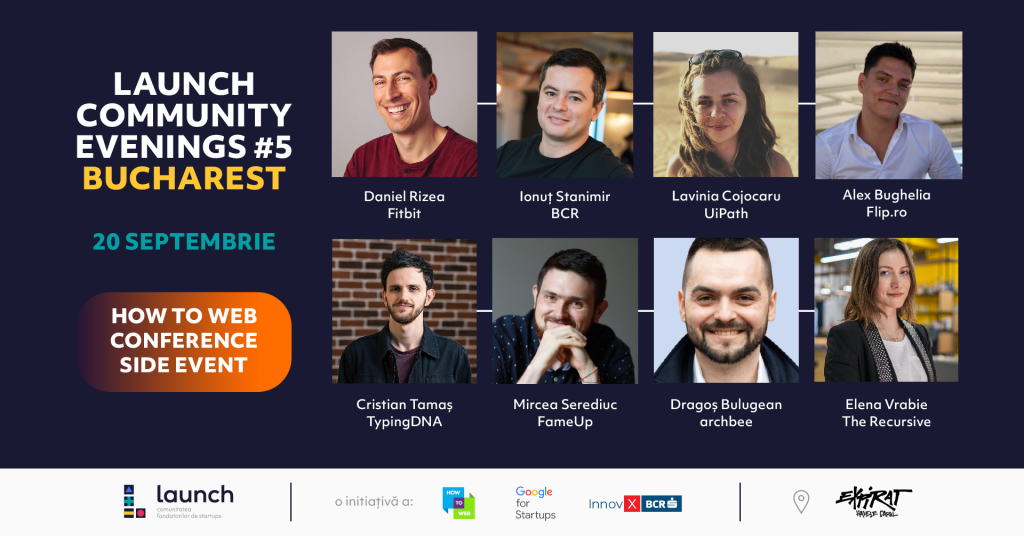
Scena locală de startup-uri, tehnologie și inovație se întâlnește pe 20 septembrie, înainte de How […]
Citeste mai mult
Scorul BRICE (găsești aici un template de framework) îți oferă un mod consistent de-a evalua, într-un mod obiectiv, viitoare sau potențiale dezvoltări de produs.
Citeste mai mult
Pirate metrics este printre cel mai cunoscut set de metrici și acronimul vine de la: Acquisition, Activation, Retention, Referral, Revenue.
Citeste mai mult
Lean Canvas răspunde unei nevoi cheie pentru startup-ul tău: aceea de documentare a planului pe care îl ai pentru acesta și, mai mult decât atât, te ajută să identifici asumpțiile majore pe care le ai.
Citeste mai mult
Pe lângă energie și entuziasm, într-un startup tech ai nevoie de un set de instrumente care să te ajute să dezvolți un produs de succes.
Citeste mai mult
Launch, comunitatea fondatorilor de startups este o inițiativă a How to Web, Google for Startups, […]
Citeste mai mult
At the earliest stages of a startup, traction is fragile, metrics are incomplete, and the […]
Citeste mai mult
👋 Cine sunt eu și de ce scriu asta? Hey, Mara sunt, CEO & Co-founder […]
Citeste mai mult